


Valeria is a teacher and mentor in the project. She coordinates and supports the classroom implementation of Following the Cairo Geniza at Ironi Alef Junior High School in Haifa, with seventh-grade students.
Toward the end of the Following the Cairo Geniza project, we held a concluding session with the students, myself, and the lecturer, Shai. The purpose of the session was to bring together all the knowledge and tools the students had acquired throughout the process and move into the applied stage: hands-on work transcribing historical sources.
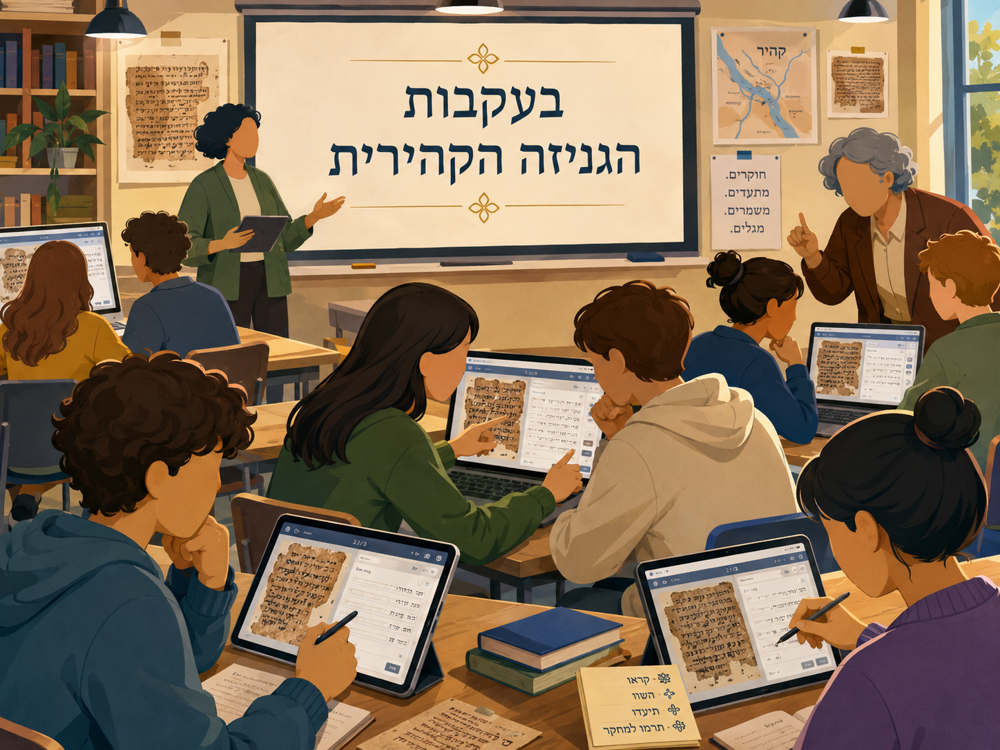
During the activity, the students logged into a dedicated application containing scanned documents from the Cairo Geniza. These were ancient texts, some of whose letters were unclear. The students were asked to identify the texts and correct the AI-generated transcription, thereby contributing to research and helping make these sources accessible to the public.
The activity ran smoothly. No major difficulties arose, but I noticed something I had not expected: the students demonstrated a high level of language ability, even though the school generally faces challenges in this area. Many of them succeeded in the task and even asked to move on to higher levels of difficulty. Shai came prepared with collections at different levels, so each student received an appropriately tailored challenge.
During the activity, I saw that some of the students were completely absorbed in the task. They became deeply engaged in the process, and among some of them, a friendly competition even developed around the quantity and quality of their transcriptions.
The event unfolded as I had expected, partly thanks to the preparation that had taken place beforehand. The students knew what was expected of them, came prepared, and were even eager to apply the knowledge they had gained.
The event was meaningful for me because I saw students taking part in actual academic research and learning together with researchers from the University of Haifa. For many of them, coming from a low socioeconomic background, this is not an experience that can be taken for granted. Their participation allowed them to encounter the world of academia and imagine future possibilities that are not always present in their immediate surroundings.
My contribution to the process included choosing the class, preparing the students, and leading the learning throughout the project. Although the materials were well organized, I was responsible for mediation, adaptation, guidance, and for creating the motivation to participate and gain value from the experience.
This experience strengthened my understanding of how important it is to create opportunities for students to encounter academic institutions. My personal connection to the University of Haifa, where I studied, gained new meaning when university lecturers met my own students. It also reinforced my belief in project-based learning and in the importance of moving from frontal teaching toward active and meaningful learning.
The central message I take from this experience is the importance of citizen science as an educational tool, and the need to expose students to the academic world from a young age, especially when the university is located in their own city.
Comments
0No comments yet. Yours could be the first.