


Yael Binder-Mashiach is a lead teacher in the Sleep: One Third of Life project at Armonim School in Ramat Gan, working with the Amirim group of sixth- and seventh-grade students.
Yael Binder-Mashiach, a teacher at Armonim School in Ramat Gan, led the participation of the Amirim group, consisting of sixth- and seventh-grade students, in the Sleep: One Third of Life project. For her, choosing this project stemmed from a desire to expose her students to new skills and to forms of learning that differ from the regular routines of school life.
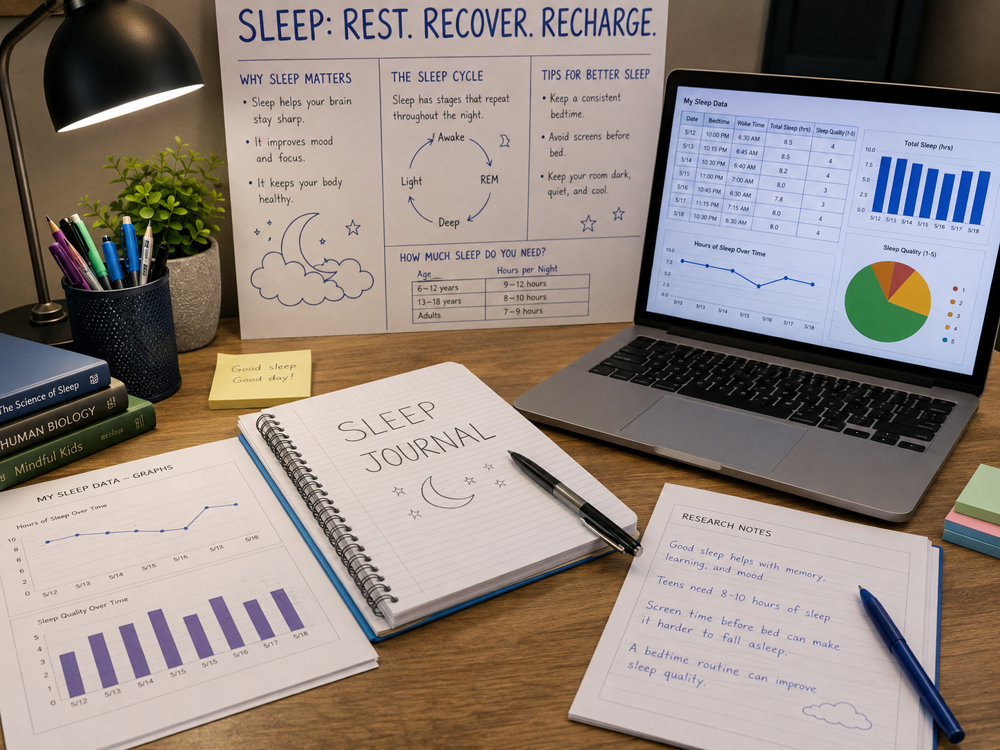
She explains that her initial exposure to the world of citizen science sparked both interest and enthusiasm. She wanted to create an experience in which her students would not merely learn existing knowledge, but would become active partners in creating it. In this project, the students took on two roles: on the one hand, they participated in collecting data about themselves by documenting their sleep habits; on the other, they acted as researchers by formulating research questions, analyzing data, and presenting their findings.
In the early stages of implementation, Yael introduced the students to the principles of scientific inquiry and guided them through the process. Later, as they moved into independent work, the students began leading the process themselves — from choosing their research questions to creating scientific posters. Yael continued to support and guide them when needed, but the main work was carried out by the students themselves.
According to Yael, the transition from the theoretical stage to the practical stage was a turning point. While the students’ responses in the initial stages were more moderate, their engagement increased noticeably once they began working with the data and conducting their own inquiry. They showed interest, looked forward to working on their final products, and were excited by their ability to analyze data and draw conclusions. Some even said they had learned new things and presented their work with pride.
Participation in the project contributed to the students in a variety of ways. They experienced a full inquiry process, developed skills in asking questions, critical thinking, and data analysis, as well as skills related to working in heterogeneous teams, presenting in front of an audience, and persevering over time. The requirement to complete a sleep journal for 14 consecutive days also strengthened their sense of responsibility and commitment to the process.
For Yael, participating in the project sharpened pedagogical beliefs she already held. She describes how the process reinforced her understanding that students are capable of coping with complex challenges, and that setting high expectations, alongside appropriate guidance, enables them to develop both confidence and competence. As she puts it, “The more opportunities you give them, and the more you expect of them, the more they develop both abilities and confidence.”
In addition, the project gave her an opportunity to encounter the world of research through meetings with professionals, and to see up close how her students engaged in high-level inquiry processes.
In conclusion, Yael describes the project as an experience that deepened learning for the students and demonstrated how moving from theoretical learning to experience-based learning can contribute to a more meaningful understanding of the subject matter, while also fostering skills that are relevant to students’ lives.
Comments
0No comments yet. Yours could be the first.