




Three courageous teachers who are constantly searching for tools and methods to diversify their teaching and make learning more meaningful joined me in a special research challenge: a citizen science project in the learning sciences on the TO BE platform.
What is the TO BE platform?
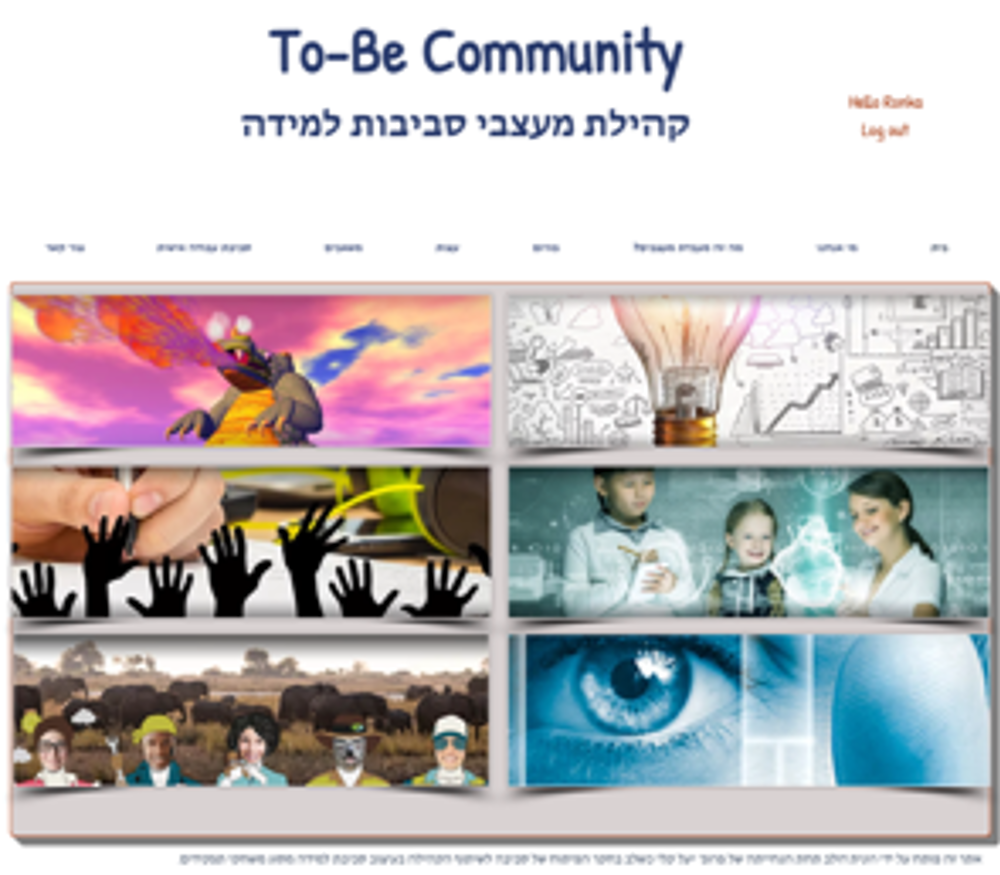
A tool for creating multi-participant learning games designed to enable learning through role-playing across different subjects, centered on a multi-perspective dilemma. Teachers and students alike can create a game and/or participate in one as players. Creating a game involves writing a framing story around a dilemma, designing characters that represent different perspectives on the dilemma, and adding relevant sources intended to help the participating students take part in discussion actively and present evidence-based arguments.
Students in grades 8 and 10 experienced both creating and participating in the games. The class was divided into groups, and each group was asked to create a learning game on to-be.co.il covering a different part of the curriculum. The subjects included history, sociology, civics, and homeroom.
What does this have to do with citizen science?
A partnership was formed between learning sciences researchers, the teachers, and the students who took part in creating the games. It was a unique kind of partnership in which each party could contribute meaningful knowledge from their own perspective. It also contributed significantly to the collection of data about students' ways of learning, through interviews conducted with the game designers (both teachers and students), feedback from the student players, and the game feed. Of particular value to the research were the design journals kept by the game design groups, and the insights presentation they delivered to the whole class, around which a discussion took place at the end of the process.
It was a fascinating journey. Students encountered both the challenges of teaching and the challenges of learning within a technology-based learning environment. Throughout the experience, students grappled with design challenges and developed insights which they brought to discussion with their classmates.
Below are several key insights:
A conversation about effective group work emerged. Students discussed among themselves and decided how they would work as a group, how best to divide the work so that everyone could contribute, how to work together efficiently in a way that gave space to all group members, and how to handle "free riders" or dominant students.
When they needed to write the framing story for the game, students had the opportunity to wrestle with the question of what makes a good framing story and how relevant it needs to be in order to draw players into a particular period or reality. They engaged in collaborative thinking about what kind of story to choose: adventure, romance, drama, or perhaps a mystery format. They considered how to approach the synopsis, whether it should reflect the full story or be written in a way that sparks curiosity among participants.
Students learned about the concept of a dilemma and the difference between it and a "problem," as well as how to present a dilemma in a correct and engaging way.
In order to give players information that would help them hold a substantive discussion, they deliberated over which knowledge sources to include. Out of familiarity with students and in order to make things manageable for them, they read and merged reading materials, summarized and selected what to use for their game, so that the reading would be interesting and useful for the game participants. Students shared enthusiastically about their experiences. As one student said: "I read 8 articles, I would never in my life have read so much. I condensed them into small, focused paragraphs so that the students would have exactly the material they needed to understand the topic and build a strong argument around it." Students found varied ways to present background material for the game: they highlighted the important sections of articles for reading, searched for relevant YouTube videos to engage as many players as possible, and condensed long articles into a few paragraphs.
Designing the game involved deliberation about the quality of the discussion that would develop around it, and about the question of what would lead students (the players) to present strong arguments and develop productive discussion around them. They encountered situations in which the character a student was asked to portray did not align with their own views, and they had to try to convince the other participating students of something they themselves did not believe.
One of the students' main sources of enjoyment was in choosing and designing the characters who would play a role in the story. Much thought was devoted to the characters' roles in the plot, their backstories, and the way they were presented. One of the challenges was getting participants to step into the shoes of a specific character they could identify with even if they thought differently from that character.
This outside perspective creates among game participants a broad understanding of a reality in which multiple perspectives exist. One student put it this way: "I hate Tobi because every time he makes me change my mind."
At the end of the game, participants were asked to respond to feedback questions formulated by the student game designers. As a result of the responses, the game designers benefited from a reflection that allowed them to understand what would be worth improving. Following the feedback, students asked to revise the games before the whole year group played them, and even requested to return to designing learning games on a different subject the following year.
In summary, exposing students to the TO-BE platform and involving them in peer teaching while engaging with interesting dilemmas encouraged the presentation of complex ideas in the context of the relevant subject area, and the cultivation of norms of discourse around them and in general, all while creating a meaningful bridge between the world of learning sciences researchers and the learners themselves.
More resources









Comments
0No comments yet. Yours could be the first.