

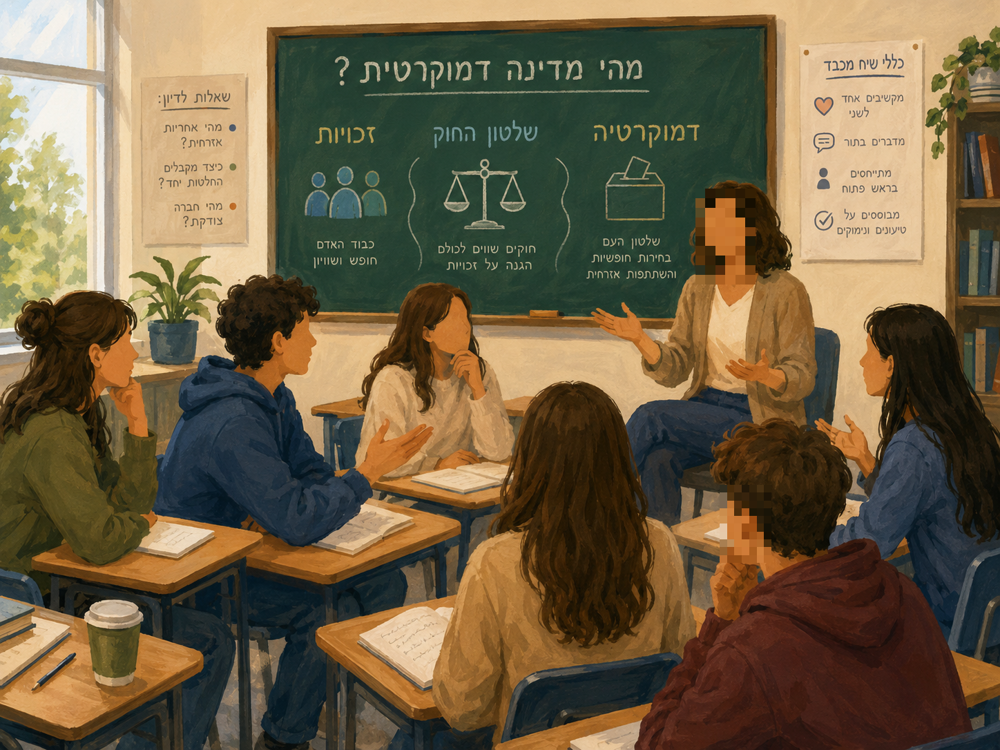
Leah Zazon, a twelfth-grade homeroom teacher and civics teacher, participated in the Democracy Inquiry project at Ironi Gimel School in Haifa with her twelfth-grade students.
I have been teaching civics for many years, so when I was offered the opportunity to take part in the Democracy Inquiry project, I was very curious. I wanted to expand my own knowledge, and also give my students access to content that does not always fit into the regular curriculum. In civics, we deal with principles, rights, and the meaning of living in a democratic state. The project opened up an opportunity for both my students and me to explore these issues more deeply and from additional perspectives.
Before each lesson, I studied the materials in depth and prepared carefully. I felt that I, too, was learning throughout the process. The class in which I implemented the project was a twelfth-grade class at Ironi Gimel School in Haifa. It is a neighborhood school in Neve Sha’anan, characterized by considerable social and economic diversity. Alongside students from a wide range of backgrounds, the class also included two Druze students. The students were approaching the end of high school and preparing for military service, and the discussions we held often connected to questions that concerned them about the society and country they were about to enter as adults.
The most meaningful event for me took place during the lesson led by the project facilitator on the question of why democracies die. Before that lesson, most of the class tended to hold clearly right-wing political views. Some of the students had hung a sign in the classroom with a picture and the words “Bibi the King.” From my perspective, the sign was part of the classroom dynamic. The students knew my positions very well and wanted to test how I would respond, so I did not ask them to remove it. I did not expect the lesson to create an immediate change, but looking back, I realized that it marked the beginning of a process.
During the lesson, one student asked many questions, challenged ideas, and requested clarifications. Even students who did not actively participate listened with great concentration. Later, I noticed that the ideas raised in that lesson kept reappearing in classroom discussions. When I taught other civics topics, such as the rule of law or defensive democracy, the students returned to ideas from that lesson, raised new questions, and connected them to current events.
Throughout the year, I integrated news articles, investigative reports, and events from Israeli reality into my teaching. Many times, I paused a video at a meaningful point and asked the students to think, ask questions, and express their views before the conclusions were presented to them. My goal was not to tell them what to think, but to allow them to examine reality for themselves. I heard a wide range of opinions in class, including views that were not always close to my own, but it was important to me that every student feel there was room for their voice to be heard.
One discussion I remember especially clearly focused on the Nation-State Law. The two Druze students shared their feelings and the way they experienced the issue, particularly during the war. Other students expressed different views. The discussion was complex, but by the end, the students were also able to identify points of agreement. For me, this demonstrated that meaningful dialogue is possible even when there are disagreements.
Another example involved watching current-affairs content dealing with public and legal issues. After watching and discussing it together, students began to reconsider positions they had previously held. What mattered to me was not whether they changed their minds in one direction or another, but the very willingness to pause, check facts, ask questions, and re-examine the reality around them.
Over the course of the year, I noticed a gradual change. It did not happen in a single day. It appeared in the questions the students asked, in the things they wrote, in the discussions they held, and in the way they related to public issues. Students who had come in with firm positions began to examine them more critically. They became more interested in what was happening around them and tried to understand the complexity of reality. One symbol of this process was that, at a certain point, the students themselves decided to remove the sign.
One moment in which I felt just how much the students had begun to take an interest in politics and listen to its complexity took place outside the classroom. At a communications exhibition held at the auditorium in Haifa, students, parents, and staff members were present. During a conversation that developed between my partner and one of the mothers, who holds a senior position in the Israel Prison Service, they discussed changes that had been made in the prison system and their professional implications.
The students standing around us listened to the conversation, and at some point realized that my partner was pointing to certain positive aspects of the changes made in the system. Immediately, the students began asking questions. They tried to understand how it was possible to evaluate a particular professional move without politically identifying with the person who had promoted it. My partner explained again and again that he was not expressing political support, but was referring only to professional aspects.
For me, this was a significant moment. I saw students listening, asking questions, examining what was being said, and trying to understand complexity. Instead of seeing reality only through a simple division of for or against, they were trying to understand how one can hold a more nuanced position. In my eyes, this was another example of the way the students had opened up to political discussion, listening, and critical examination of reality.
Alongside the positive experiences, there were also parts of the program that we did not manage to complete. The complex reality of the war disrupted the continuity of implementation and did not allow us to cover everything that had been planned. One central component that remained unfinished was the debate. The students had already chosen topics, roles had been assigned, and work toward the debate had begun, but in the end, we were unable to hold it. For me, this is one of the most meaningful components of the program, because it allows students to actively practice presenting arguments, listening to different positions, and managing disagreement in a thoughtful way.
The research component was also not fully completed. Out of 32 students in the class, 18 participated in the research, and we did not reach the stage in which the students were supposed to present their findings and draw conclusions in a short presentation. I felt that this learning cycle remained incomplete. At the same time, I believe these components should not be given up. The debate and the work with research data are especially important parts of the program, because they allow students to move from engaging with ideas and concepts to actively practicing thinking, analysis, and argumentation.
I also learned about myself through this process. I learned to listen patiently to different opinions, to allow students to express themselves, and to trust that understanding and thinking can develop through dialogue. I rediscovered how important it is to create a safe classroom space where students can ask, argue, agree, and disagree. I think the relationship built over three years of being their homeroom teacher allowed the students to feel comfortable expressing different positions and engaging in open discussion, even around sensitive and controversial topics.
The main message I take from the project relates to the teaching of civics itself. In my view, civics cannot be taught only through memorization. To teach the subject meaningfully, the teacher must deeply understand democratic principles, rights, and the connection between them and reality. When the teacher understands, they can help the students understand as well.
I say this also from my experience of 34 years in the education system. Over the years, I have met many teachers, and at times I feel that some teach the material for the matriculation exam without deeply understanding the meaning of the democratic principles, rights, and civic complexity behind it. When the teacher does not truly understand the subject, it is difficult for the students to understand it. Civics can become a subject of memorization instead of a subject that helps students understand reality.
For me, the Democracy Inquiry project was an opportunity to strengthen this understanding and make learning relevant, alive, and connected to the world in which the students live. Especially during a complex and unsettling period, I saw how students are capable of asking better questions, listening to different opinions, examining reality critically, and understanding that democratic life is more complex than slogans or simple positions of for and against. In my eyes, this is one of the most important gifts that civics education can give them.
Comments
0No comments yet. Yours could be the first.