


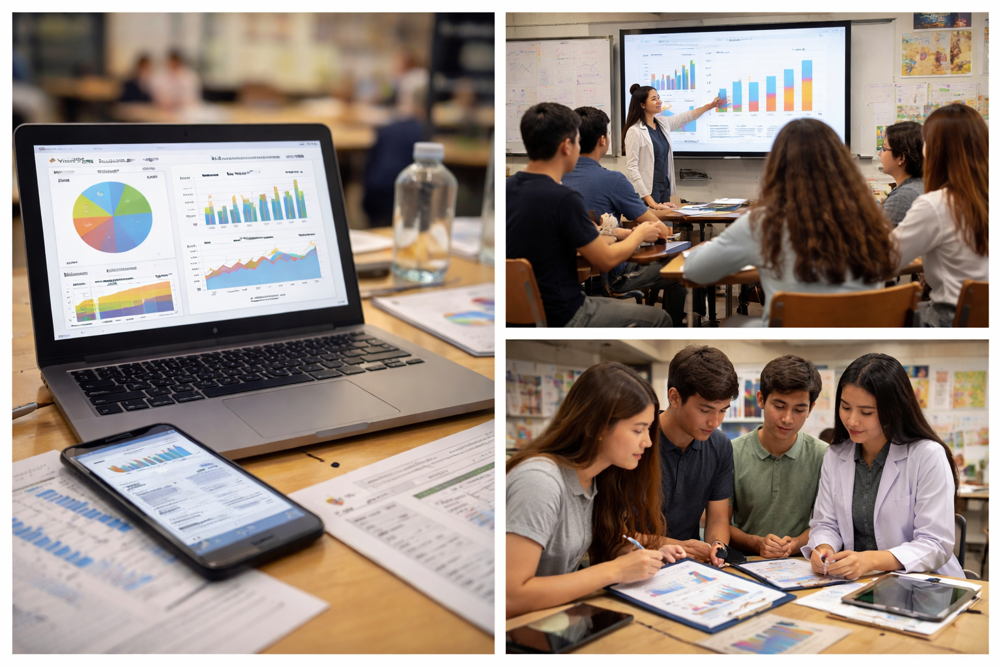
Limor Raduskovitz, a lead teacher in the “Sleep – A Third of our Life” project at Tel Aviv Municipal School D, with her 9th-grade students.
As part of the “Sleep – A Third of our Life” project, Limor Raduskovitz guided her 9th-grade students through a scientific research process that explored questions about the sleep habits of adolescents. Her goal was to enable the students to experience real scientific research, which is research that relates to their personal lives, sparks curiosity, and allows for active participation. To this end, she connected the group of students with academic mentors and worked with them on the process of formulating questions, research guidance, and data analysis. Limor led the project from start to finish: from the stage where the research background was presented, through coordinating collaborations with the academic community, to the practical implementation of the research, which included two intensive weeks of administering a sleep survey. She then guided the students in analyzing the data and drawing conclusions, comparing the class’s data with data from a national database.
Each group was asked to submit a final report, structured scientifically and including a background, findings, and discussion. According to her, the very experience of designing a study, collecting data, and writing a critical discussion was a unique and extraordinary process for the students, both pedagogically and in terms of the scope of the work. They showed interest and cooperated, and she claims, “they worked on very interesting data.” Limor emphasizes the project’s significant contribution to her as well. It allowed her to guide a scientifically guided research process, ask critical questions, and delve into aspects that are not always considered in routine teaching. She particularly notes the contribution of the accompanying scientists, who, she says, added depth, context, and a higher professional standard, and created motivation for both her and the staff, as well as for the students. In her view, it is important to encourage teachers to initiate partnerships with recognized research institutions. Such partnerships not only advance students’ learning but also serve as an important channel for the professional development of teachers within the school community. Involving educators in research, especially research focused on teaching practice or civic science, opens the door to further education, professional development, and active participation in the academic sphere. In her view, it is worth considering ways in which teachers can be an integral part of research, not merely as implementers, but as partners in the thinking and the entire process.
Comments
0No comments yet. Yours could be the first.